
Tempo, not technique: hunting the AI harnesses behind today’s intrusions
Nov 2, 2026
RST Labs · data as of 2 November 2026
The speed problem
The intrusions making headlines this autumn are not clever. They are fast.
Microsoft reported that Storm-0940 used ARTEX to attempt sign-ins to more than 2,250 tenants following the ConnectWise compromise. In multiple ARTEX-driven attacks, the actor gained privileged cloud access within three hours of initial targeting. Separately, Microsoft observed a password-spraying campaign targeting 327 accounts across eight organizations, but found no successful sign-ins [1]. CrowdStrike tracked VAPOR PANDA, also running ARTEX, across more than 200 organisations from 17 October [2]. One Cairn operator studied by VULONE burned through roughly 36.7 billion tokens running 66 projects against government targets in four countries [3].
None of these campaigns needed a new exploit. They needed an orchestrator that could take a goal, split it into tasks, hand them to LLM agents, and keep going around the clock. Three open-source projects now do exactly that: Cairn, ARTEX and PentAGI.
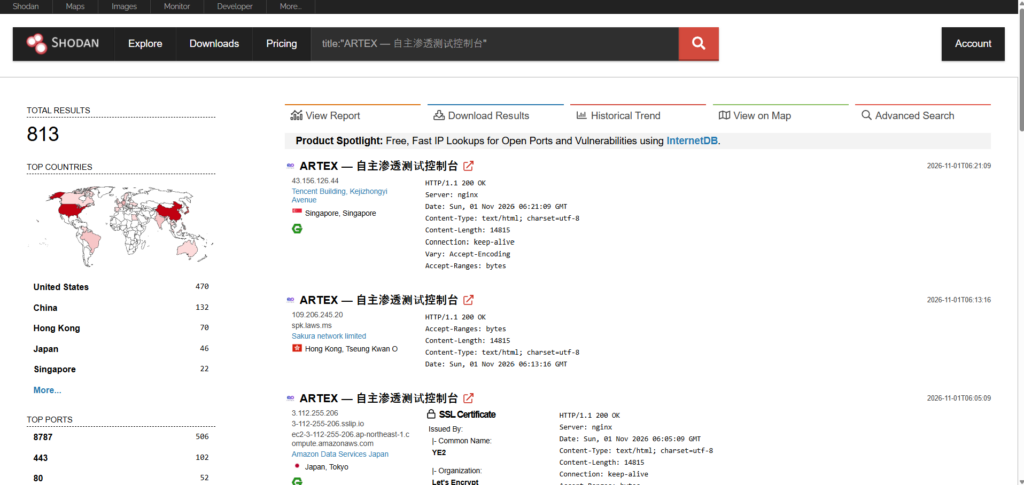
They are also easy to find. On 2 November 2026 we counted more than 1,300 internet-exposed consoles for these three harnesses, verified and deduplicated across Shodan and Netlas. Many will belong to testers. Some don’t, and from the outside the consoles look the same.
What the harnesses are
| Cairn | ARTEX | PentAGI | |
|---|---|---|---|
| Upstream | oritera/Cairn [8] | Autumn-27/ARTEX (hidden Oct 2026) | VXControl |
| Stack | Python, uvicorn, Alpine.js | Next.js behind nginx | React SPA, self-signed TLS |
| Default port | 8000 | 8787 | 8443 |
| Auth by default | None | HTTP Basic (realm “ARTEX”) on some hosts | Login page, default credentials |
| Licence / model | Open source | AGPL, forks | Open source + commercial |
| Notable derivatives | VulnFlow IoT, “Zero”, WorkerAnt | ScopeWeaver, BaaRai ARTEX, ARTEX v2, Korean build, AegisLoop | Renamed builds (“AI Pentest”, “Specter”) |
All three plan, run tools, read the output and decide the next step without a human in the loop. The operator sets the target and the rules; the harness supplies the tempo.
A login page is not the same as being safe to expose. Many ARTEX hosts answer with an HTTP Basic auth challenge (realm “ARTEX”), and PentAGI presents a sign-in screen with default credentials to change on first use; Cairn ships with none. But our scans read every console’s title, body, certificate and favicon without authenticating, so the consoles counted here are reachable on the public internet regardless, and an unprotected or default-credentialed panel is exactly what NorForge saw hijacked [6].
The Cobalt Strike pattern
We have seen this before. Cobalt Strike was built for red teams, and it became the most common post-exploitation framework in criminal and state intrusions. The AI harnesses are following the same path, faster.
- Dual use is the default. Red teams, CTF players, researchers, criminal crews and state actors all run the same code. Public reporting is weighted towards China-nexus actors, but they are the most visible users, not the only ones.
- Forks multiply. ARTEX has a backup mirror (mhtsec), a mirror of the mirror under a generic name (kutukam/autonomous-pentest-agent), an English/Korean fork (cskwork/scopeweaver, around 770 stars and 660 forks) [9] and an English translation (BaaRai/ARTEX, around 320 stars and 170 forks) [10]. The BaaRai fork adds a browser extension that captures the operator’s authenticated sessions, so agents can reuse a login after one MFA prompt.
- Takedowns don’t stick. ARTEX’s author hid the original repository in October after reports of abuse [4]. That changed who maintains ARTEX, not who can run it. Renamed mirrors don’t show up in name searches, just as rebranded consoles don’t show up in title searches.
How they are used
Cairn: one endpoint to full takeover. ReliaQuest followed a Cairn-driven intrusion from a single exposed Spring Batch endpoint to server takeover, with data leaving in 1,800-byte chunks. The attacker’s own Cairn panel was live on the attack-origin IP [5].
Cairn: a credit-farmed government campaign. VULONE describes a China-linked, financially motivated operator running 66 Cairn projects against government networks in Vietnam, Taiwan, Indonesia and India. A rule in the operator’s prompts forced ASCII-only payloads, and the LLM bill was paid by farming CodeBuddy credits [3].
ARTEX: bursts, probes and poisoned logs. Google’s threat intelligence team saw ARTEX activity arrive in bursts 2 to 25 seconds apart, ArtexProbe markers, MySQL log poisoning and 491 webhook.site callback URLs. GTIG also names ScopeWeaver and an “ARTEX PRO” variant [4].
ARTEX: VAPOR PANDA. CrowdStrike reports VAPOR PANDA using ARTEX against more than 200 organisations, with operator instructions marked by 【人类指令】 (“human instruction”) tags. The actor looked specifically for hosts without an EDR agent, and deployed BLOODALCHEMY afterwards [2].
ARTEX: Storm-0940. Microsoft links Storm-0940 to ARTEX after a ConnectWise supply-chain compromise. ARTEX drove sign-in attempts at more than 2,250 tenants and Microsoft Graph reconnaissance, and in several intrusions reached privileged cloud access within three hours of initial targeting. A separate password-spraying campaign against eight organisations produced no successful sign-ins [1][7].
The hunters get hunted. NorForge documents two clusters, AIA0009 and AIA0010, hijacking exposed Cairn panels to steal API keys and SSH keys and to deploy Poseidon [6]. An open harness console is a target in its own right.
Hunting guide
Internet exposure
Every harness can be found by more than one feature. The strength of each, weakest to strongest:
title → port → favicon → certificate → body/template code
The default fingerprints below are easy to change, so publishing them costs nothing; operators who care about being found have already changed them. They are a starting point for defenders who have not begun looking.
| Harness | Starting-point fingerprint | Notes |
|---|---|---|
| Cairn | Shodan product:"Cairn"; title Cairn with server: uvicorn | Title alone is noisy, see below |
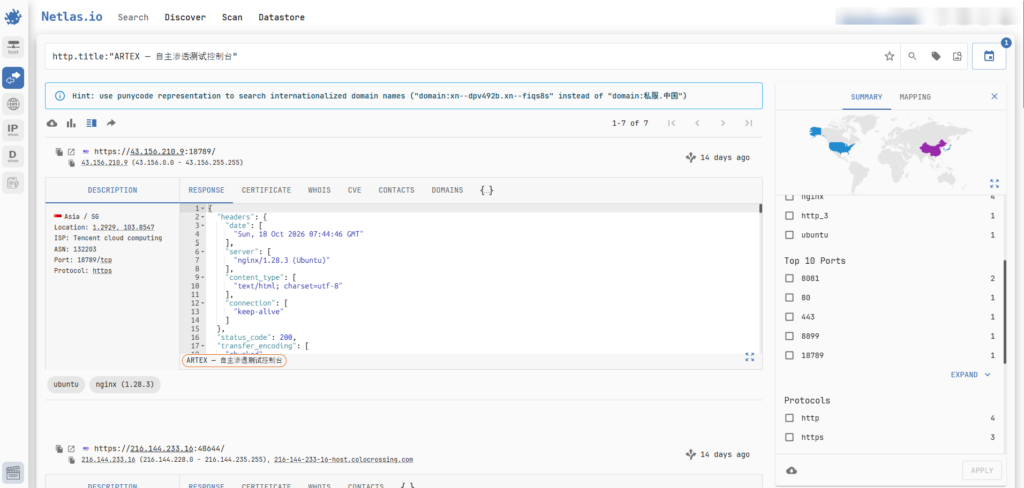
| ARTEX | Title ARTEX — 自主渗透测试控制台 | The em dash (U+2014) matters |
| ARTEX | HTTP Basic auth realm ARTEX (WWW-Authenticate header) | Title-independent; present where the console is behind Basic auth |
| ARTEX | Titles ARTEX: Autonomous Penetration Testing Console, Agent Security Workbench | English build, v2 |
| PentAGI | Cert issuer CN PentAGI CA | Default self-signed cert |
| PentAGI | Favicon: Shodan http.favicon.hash:-1596753120, Netlas SHA-256 2a620e3c5f7b49dfc6f5278352607f7931f8c38ef9d4689908af65538dd95366 | Shodan uses MurmurHash3, Netlas SHA-256 |
| All | Default ports: Cairn 8000, ARTEX 8787, PentAGI 8443 | Roughly a third of consoles run elsewhere |
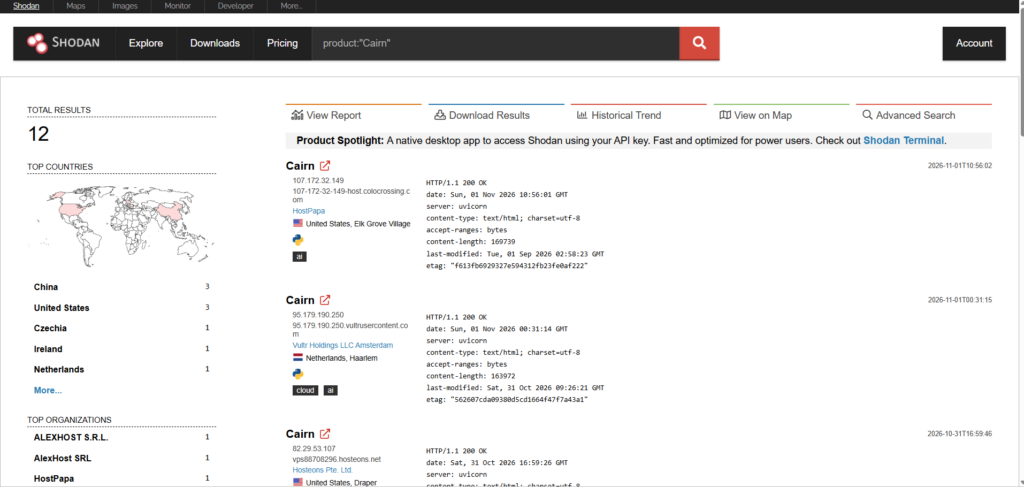
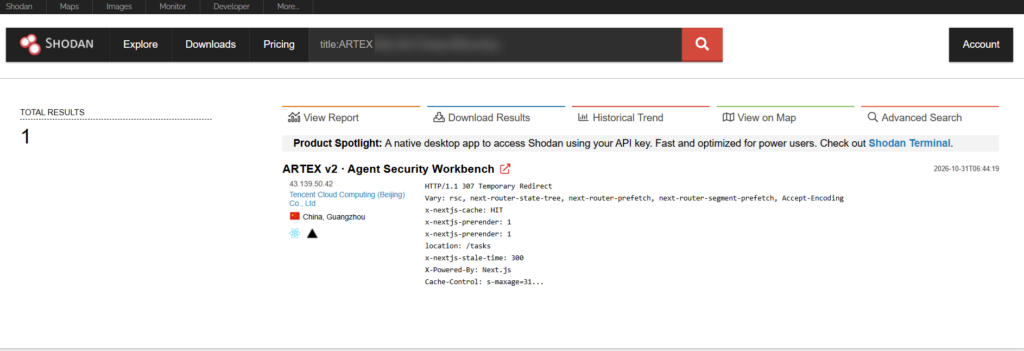
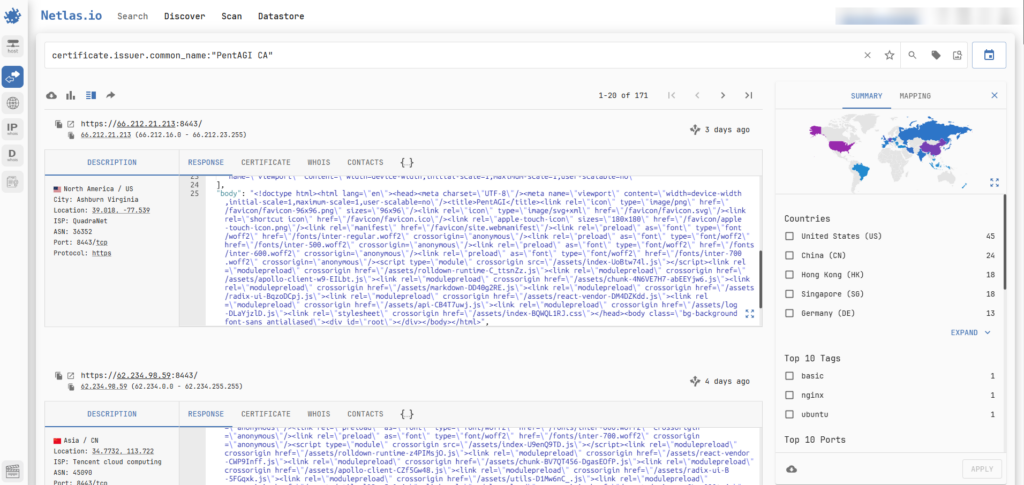
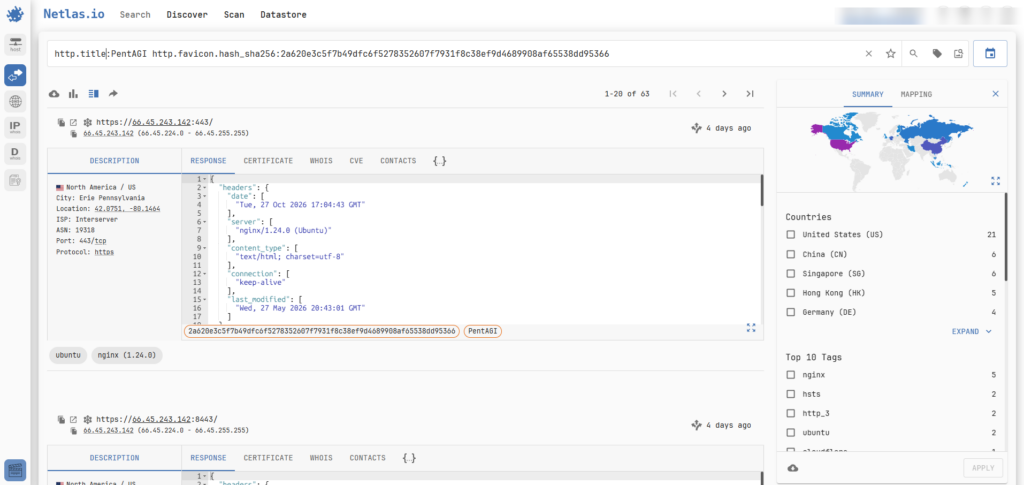
The durable fingerprints are in the page code, and we are deliberately not publishing them. They are functions from each harness’s data model and distinctive UI elements that forks inherit even after renaming the app, and they are what found VulnFlow IoT, Zero and ScopeWeaver. Printing the exact strings would tell fork authors precisely what to change. RST Cloud tracks exposed Cairn, ARTEX and PentAGI consoles, including renamed builds and forks, and delivers them to customers as part of the RST Threat Feed.
Three lessons from building these:
- Titles alone are noise.
title:"Cairn"returned 407 hosts; only 56 were Cairn. The rest were holiday cottages, a trekking firm, a fit-out company and an unrelated app on Amazon S3. - OR independent features for recall, then AND a family-specific marker for precision, then deduplicate by IP.
- Generic framework strings are filters, not fingerprints. Class names and internals from Next.js, Vite or Tailwind appear in thousands of unrelated apps. Use them only to narrow results that a harness-specific feature has already found.
How each kind of variation is caught:
| Variation | What catches it |
|---|---|
| Default install | Title or product search |
| Renamed title | Body or template strings |
| Rebranded fork (VulnFlow, ScopeWeaver, ARTEX v2) | Framework code shared by derivatives |
| Non-standard port | Full-port targeted scans |
| Own certificate | Title/favicon union |
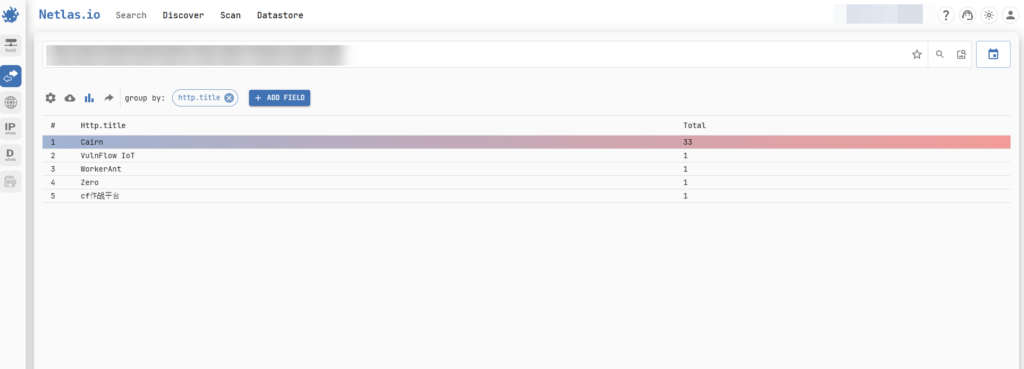
Forks are a bigger blind spot than renaming. Searching on Cairn’s template code surfaced consoles titled VulnFlow IoT, WorkerAnt, Zero and cf作战平台, none of which a title search for “Cairn” would return. Some, like VulnFlow IoT, are separate products built on Cairn rather than disguised copies of it.
Victim telemetry
Static markers are the easiest to hunt and the easiest for a fork to remove. Behaviour survives changes of model, prompt and branding, so weight it more heavily.
- Files named
artex-probe-*, and accounts namedArtexProbe. artxorartexin command lines, cloud role names and working directories (for exampleC:\ProgramData\artx5v\).- Callbacks to rotating webhook.site URLs; GTIG counted 491.
Behavioural patterns
- Machine cadence. Commands or requests arriving seconds apart, around the clock, with no human pauses. ARTEX bursts land 2 to 25 seconds apart [4].
- Self-correcting payloads. A sequence of near-identical commands where each one fixes the previous error. Humans rarely retry this fast or this tidily.
- Machine-formatted output. Scripts that print pipe-delimited results, explicit exit codes or banners, and throwaway code with comments explaining its own reasoning.
- Fixed-size exfiltration. Output leaving in uniform chunks (about 1,800 bytes in the ReliaQuest case), often through sequentially named jobs or files with offsets [5].
- ASCII-only payloads with no language artefacts [3].
Cloud and identity [1]
- A new sign-in followed within minutes by Microsoft Graph enumeration, and bursts of failed sign-ins across many accounts (spraying), even when none succeed.
python-requestsorPython-urllibuser agents in Graph and sign-in logs.- A service principal signing in, then assigning itself a role.
- Bursts of permission dry-runs and deployment validation calls with no deployment following.
Targeting
- Hosts without an EDR agent picked first [2].
Harnesses hijacked
Cairn ships with no authentication. NorForge shows what happens next: other actors take over the panel, steal the operator’s LLM API keys and SSH keys, and turn the infrastructure against its owner [6]. If you run these tools for legitimate testing, put them behind a VPN or authenticating proxy, and never expose the console port.
What the internet shows
Exposed consoles, 2 November 2026
| Harness | Verified hosts | Shodan only | Netlas only | Both |
|---|---|---|---|---|
| Cairn | 56 | 25 | 16 | 15 |
| ARTEX | 834 | 754 | 28 | 52 |
| PentAGI | 459 | 242 | 59 | 158 |
| Total (unique IPs) | 1,341 |
For comparison, Censys alone shows 1,261 hosts tagged with ARTEX software, 506 PentAGI consoles and 30 Cairn consoles (2 Nov 2026), nearly 1,800 in all. We could not deduplicate these against our data, so they are not included in the totals.
Where they run
| Top hosting countries | Default port share | |
|---|---|---|
| Cairn | US 21%, CN 14%, NL 12%, IR 7% | 95% on 8000 |
| ARTEX | US 55%, CN 14%, HK 9%, JP 6% | 65% on 8787 |
| PentAGI | US 43%, HK 11%, CN 11%, DE 7% | 69% on 8443 |
Hosting is concentrated. Roughly 300 ARTEX consoles, more than a third of the total, sit in a single network (AS54600), and about 90 PentAGI consoles sit in another (AS398823). Both blocks are registered to Cogent in WHOIS, but neither is announced by Cogent’s own network, so the concentration points to a reseller or VPS provider rather than Cogent itself.
Country is where the server is hosted, not where the operator sits. The US leads because that’s where the cloud capacity is.
What the numbers say
- No scanner sees everything. For the same ARTEX title, Netlas found 37 hosts, Shodan 708 and Censys 1,223. Each figure here is a lower bound.
- Some consoles show no title at all. 96 ARTEX hosts answer only with an HTTP Basic auth challenge (realm “ARTEX”), so a title or body search never sees them. The authentication header was the only evidence, and it added more than a tenth to the ARTEX count.
- Combining sources matters most for small populations. Shodan found 40 Cairn hosts and Netlas 31, but only 15 were seen by both: merged, the count is 56.
- Non-default ports are common. About 35% of ARTEX and 31% of PentAGI hosts run only on non-default ports, and PentAGI has large clusters on 8666 and 8765.
- Titles are not enough. For every harness we found consoles that a default-title search misses. We did not set out to find them all, and the examples below are a sample, not a census:
| Harness | Examples found under other titles |
|---|---|
| Cairn | VulnFlow IoT, WorkerAnt, Zero, cf作战平台, “Cairn · 事实图谱协同探索”, “Cairn(中文界面)” |
| ARTEX | Korean builds (“ARTEX: 자율 침투 테스트 콘솔”), “AegisLoop — 攻防安全运营”, “ARTEX v2 · Agent Security Workbench”, “ScopeWeaver — Autonomous Penetration Testing Console”, a lower-case “artex — 自主渗透测试控制台” |
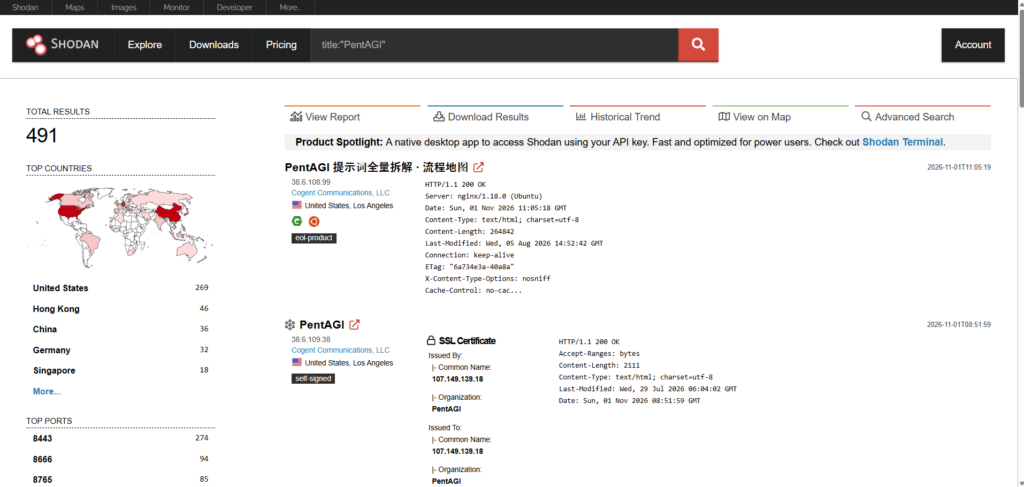
| PentAGI | “AI Pentest”, “Specter”, “xhackai”, “PentestAI”, “天融信 AI渗透测试系统” |
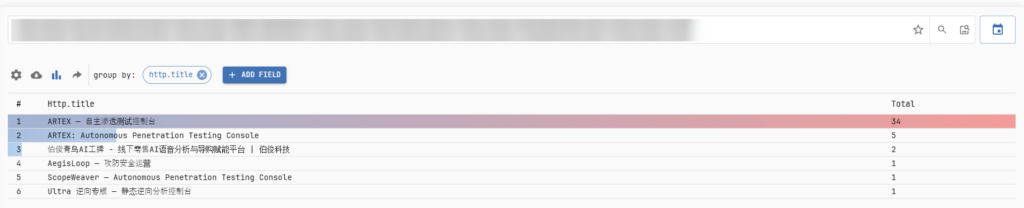
Each was found through a stronger feature: template code, certificate, favicon or a family-specific body string. Anyone hunting these tools by title alone will miss them.
Reputation of what we found
An exposed console is not malware, so we did not expect antivirus engines to flag these hosts. We checked a sample on VirusTotal anyway, to see whether reputation data tells defenders anything the exposure data does not. Two groups: hosts that only surface when you hunt past the default title (renamed builds, forks, and servers running two harnesses at once), and a baseline of stock default-title consoles.
Hunted hosts (renamed, forked, or multi-harness)
| Host | What it is | Port | Country | VT |
|---|---|---|---|---|
| 23.226.135.117 | PentAGI as “xhackai” | 8443 | US | 8/92 |
| 1.14.104.208 | ARTEX + PentAGI on one server | 8443/8787 | CN | 7/92 |
| 43.139.50.42 | ARTEX v2 · Agent Security Workbench | 3000 | CN | 6/92 |
| 51.158.154.152 | ARTEX + PentAGI on one server | 8443/8787 | NL | 3/92 |
| 156.240.236.6 | Cairn as “cf作战平台” | 8001 | HK | 2/92 |
| 8.216.41.60 | Cairn as “Zero” | 8000 | JP | 1/92 |
| 84.247.152.233 | ARTEX + PentAGI on one server | 8443/8787 | NO | 0/92 |
| 5.255.124.144 | ARTEX as “ScopeWeaver” | 8080 | NL | 0/92 |
| 119.45.26.102 | PentAGI as “天融信 AI渗透测试系统” | 18089 | CN | 0/92 |
| 123.57.3.71 | Cairn as “VulnFlow IoT” (live, confirmed 2 Nov) | 8000 | CN | 0/92 |
Baseline (stock default-title consoles)
| Host | Harness | Port | Country | VT |
|---|---|---|---|---|
| 176.65.144.71 | Cairn | 8000 | DE | 15/92 |
| 43.250.53.42 | Cairn | 8000 | AU | 12/92 |
| 117.72.220.70 | ARTEX | 8787 | CN | 12/92 |
| 31.57.47.29 | Cairn | 8000 | NL | 6/92 |
| 38.11.221.26 | ARTEX | 8787 | US | 0/92 |
| 111.228.36.150 | ARTEX | 8787 | CN | 0/92 |
| 82.25.190.221 | PentAGI | 8443 | NL | 0/92 |
| 124.223.104.170 | PentAGI (live, confirmed 2 Nov) | 8443 | CN | 0/92 |
| 23.95.170.215 | PentAGI | 8443 | US | 0/92 |
Exposure is not reputation. The scores do not separate the hunted hosts from the stock ones. Several renamed and multi-harness panels carry detections (up to 8/92), but so do plain default consoles (up to 15/92), while other live, confirmed-exposed consoles, including a running Cairn fork, sit at 0/92. The detection count tracks the hosting more than the tool: the highest scores here are on abused or shared VPS ranges that would score high whatever they ran, and a console on a clean provider scores zero even when it is live and findable. A VirusTotal zero does not mean safe; it means unreported. For infrastructure like this, a raw reputation count is a weak signal on its own, and needs weighting by hosting context, exposure and the dual-use nature of the tool before it can drive any action.
Methodology
- Data was collected passively from Shodan, Netlas and Censys. No console was accessed.
- The unit is a unique IP; services (IP plus port) are reported separately.
- A host is counted only if a family-specific query found it, or if a title/port match also had a family marker in its stored body, favicon or certificate. Lookalike pages (for example a PentAGI prompt-explainer page that copies the stock favicon) are excluded by hand.
- A targeted Netlas scan of selected ranges, covering non-standard ports, added hosts that the public crawls missed.
- An exposed console is not proof of malicious use, and tool presence is not attribution.
Defensive takeaways
- Plan for tempo. Hours, not weeks, from first touch to privileged access. Automate containment for password-spray and Graph-recon patterns.
- Close the EDR gaps. At least one actor goes looking for unmanaged hosts first.
- Hunt the harness, not the exploit. Burst timing, probe markers, webhook callbacks and fixed-size exfiltration chunks survive changes of model and prompt.
- Watch your own exposure. Red teams running these tools should never expose the console. A hijacked harness hands your keys and access to someone else.
- Track forks, not names. Fingerprint body and template code, and expect the next rebrand.
References
- Storm-0940 uses ARTEX: agentic AI and a ConnectWise supply-chain compromise
- VAPOR PANDA uses ARTEX to scale global campaign
- A China-linked operator used AI agents to attack governments across Asia
- Google Threat Intelligence Group, ARTEX and friends: enter agentic offensive frameworks
- How AI agents turned one exposed endpoint into a server takeover
- Automated subversion and attempted takeover of AI pentesting harnesses
- ARTEX in the Wild: Storm-0940 expands targeting of IT and software vendors
- oritera/Cairn, GitHub
- cskwork/scopeweaver, GitHub
- BaaRai/ARTEX, GitHub