
Part of the RST intelligence layer

RST Honeypot Network
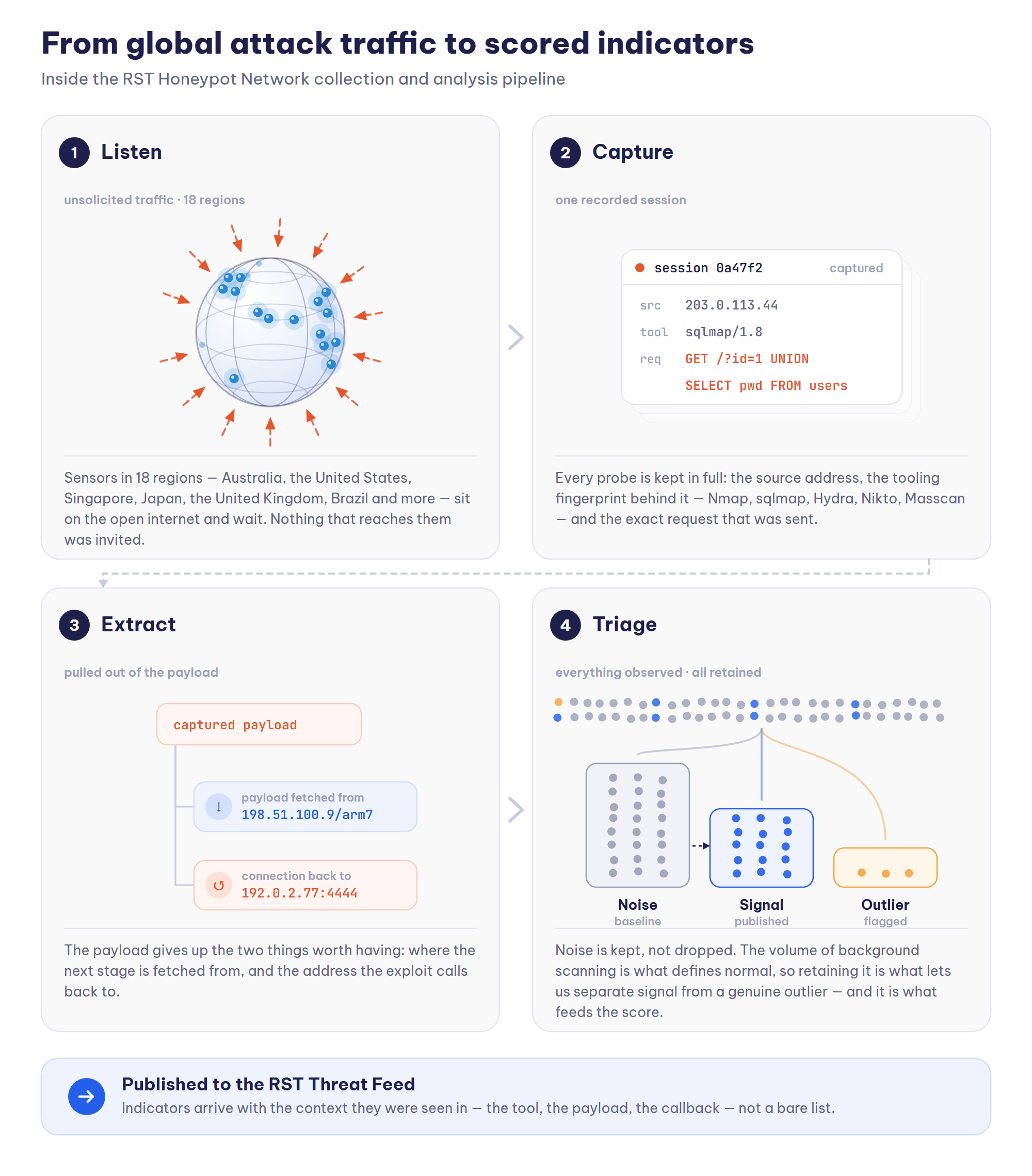
Sensors on the open internet in 18 regions — every packet that reaches them is uninvited, so the noise itself becomes the baseline that scores the signal.
Every packet that arrives is unsolicited. The volume of background scanning is what defines normal, so retaining it is what separates signal from a genuine outlier.
RST Cloud’s Honeypot Network provides comprehensive, real-time threat intelligence through advanced automated detection and analysis of threats worldwide. Our service delivers fresh, actionable data on global web threats, covering key regions, including Australia, the United States, South Africa, Hong Kong, India, Japan, South Korea, Singapore, Indonesia, Malaysia, Canada, Switzerland, Ireland, the United Kingdom, France, the UAE, Bahrain, and Brazil.
External Threat and Automated Attack Monitoring
Our Honeypot Network is designed to detect and analyse automated attacks originating from malicious IP addresses, complementing the RST Threat Feed with the most relevant data on active threats and their indicators of compromise. This empowers organisations with timely, actionable insights to enhance their defences against evolving cyber threats.
We monitor an extensive range of threats, from network scanning and brute-force attempts to sophisticated web application attacks. Our detection capabilities cover a wide array of known automated threats, including:
- Network Scanners and Vulnerability Assessment Tools: Recognises tools like Zgrab, Nikto, sqlmap, Nessus, Nmap, Arachni, Metasploit, OpenVAS, Skipfish, W3af, Acunetix, etc.
- Reconnaissance and Exploitation Tools: Detects reconnaissance tools like HTTrack, WebInspect, Netsparker, Burp Suite, AppScan, Zap, Vega, WebShag, Paros, etc.
- Brute Force and Fingerprinting Tools: Identifies tools like Dirbuster, Masscan, SSLScan, WhatWeb, Hydra.
Web Attack Detection and Protection
The RST Honeypot Network functions as a robust source of knowledge about web attacks, monitoring for threats such as:
- Remote Code Execution (RCE)
- Sensitive Data Exposure
- Security Misconfiguration
- SQL Injections (e.g., EXECUTE, HAVING, Chained SQL)
- Cross-Site Scripting (XSS)
- Path/Directory Traversal
- JavaScript and DOM Manipulation Attacks
- Cross-Site Request Forgery (CSRF)
- Shellcode Injection and Directory Attacks
- Unauthorised System Access Attempts
- Various encoding and obfuscation-based attacks
These capabilities enable organisations to proactively block or mitigate known and emerging threats across diverse sectors and regions.
Information Extraction and Analysis
RST Cloud’s honeypot infrastructure captures essential threat intelligence to support proactive cybersecurity measures:
- Callback Extraction: Identifies exploit callbacks and payload download sources, monitoring malicious communication attempts.
- Scanner Identification: Detects reconnaissance and automated scanning tools, allowing organisations to stay alerted to incoming probes.
- Shell Injections and Botnet Payload Sources: Tracks shell injections and botnet payload downloads (e.g. Mozi), aiding in the detection of compromised systems and botnet activity.
RST Honeypot Network empowers security teams with actionable intelligence, enabling rapid response to global threat activity and improving organisational defences against automated and targeted cyber threats.